Introduction
Traveling with fitness equipment has become increasingly common as people seek to maintain their routines while on the move. This guide explains how airline regulations affect portable Pilates reformers and offers practical advice for packing, selecting, and transporting these devices. Readers will learn which reformers are most travel‑friendly, how to comply with cabin and checked‑baggage policies, and what strategies minimize the risk of damage or extra fees. By the end of the article, one will be equipped to fly confidently with a Pilates reformer without compromising comfort or budget.
Background/Context
Pilates reformers are versatile machines that provide resistance training, core strengthening, and flexibility work in a compact footprint. Traditional studio reformers can weigh over 200 lb and require dedicated space, but modern portable models fold or collapse to dimensions suitable for home gyms. Understanding the basic components—springs, pulleys, footbars, and carriage—helps travelers assess weight, size, and fragility when planning a flight. Airlines classify such equipment either as sporting goods, musical instruments, or oversized items, each with distinct handling rules.
Airline Policies for Portable Fitness Equipment
Most major carriers treat a portable Pilates reformer as a piece of sporting equipment, allowing it in either the cabin (if it fits under the seat) or as checked baggage. The Federal Aviation Administration (FAA) does not impose a specific weight limit for sporting goods, but airlines typically enforce a 50 lb limit for cabin carry‑on items. If the reformer exceeds that threshold, it must be checked, and the passenger may be charged an oversized‑baggage fee based on dimensions and weight. Some airlines, such as Delta and United, require prior notification for oversized sports equipment, while low‑cost carriers may prohibit it entirely.
When checking a reformer, it is advisable to use a hard‑shell suitcase or a dedicated travel case with padding to protect the frame, springs, and pulley system. Declaring the item at check‑in ensures that ground staff handle it with care and that any additional fees are transparent. Travelers should also verify the airline’s policy on “fragile” labels; while these do not guarantee special handling, they can reduce the likelihood of rough loading.
How to Pack a Portable Pilates Reformer
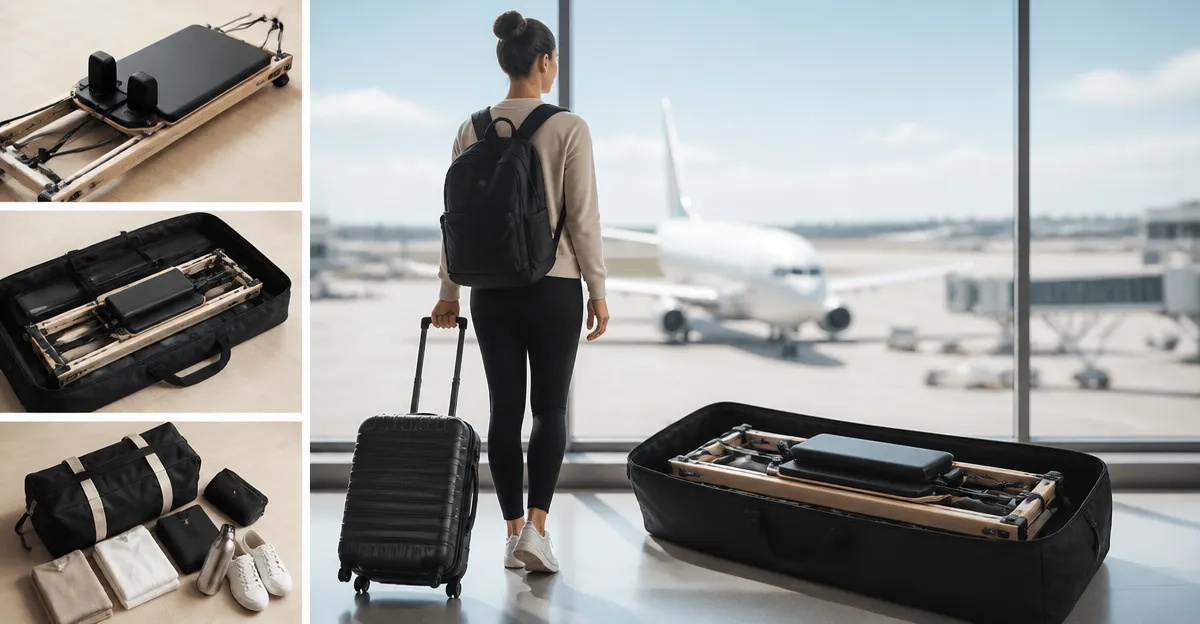
Effective packing begins with disassembly. Most foldable reformers, such as the Dpiolrcag Foldable Pilates Reformer, feature 90% pre‑assembled components, a detachable foot bar, and removable springs that can be secured with zip ties. Secure the springs in a separate pouch to prevent them from shifting during transport. Wrap the carriage and frame with bubble wrap or moving blankets, and place them inside a sturdy suitcase that measures no more than 62 inches (length + width + height) to avoid excess‑size surcharges.
For the PAETA Foldable Pilates Reformer, the extended 86‑inch length may require a larger case, but the unit folds to occupy just 1.4 sq ft. Position the folded reformer vertically within the case, and fill any voids with clothing or foam inserts to prevent movement. Include the supplied storage bags and Velcro straps to keep the stand components together. When possible, label the case as “Sporting Equipment – Pilates Reformer” to alert handlers.
The JANUA 5-in-1 Pilates Board (Model A) is lightweight and compact, making it ideal for cabin carry‑on on most airlines. Place the board in a padded sleeve and slide it into an overhead bin, ensuring it does not exceed the airline’s 22 lb carry‑on limit. The board’s resistance bands and smart timer can be stored in a separate pouch to avoid tangling.
The VEVOR Foldable Pilates Reformer weighs up to 400 lb capacity but is lighter than many studio models, typically around 80 lb. Wrap the cast‑iron frame with protective padding and use a wheeled luggage cart for easier maneuvering through the airport. If the reformer must be checked, request “fragile” handling and consider purchasing travel insurance that covers equipment damage.
Comparison of Popular Portable Reformers
The table below summarizes key specifications, price points, and travel‑related attributes of the reformers discussed in this guide. This comparison assists readers in selecting a model that aligns with their budget, space constraints, and airline policies.
| Product | Weight Capacity | Folded Dimensions | Price (USD) | Rating | Travel Suitability |
|---|---|---|---|---|---|
| Dpiolrcag Foldable Pilates Reformer | 250 lb | 1.83 sq ft (approx. 24" × 24" × 48") | 299.99 | 4.6/5 (308 reviews) | Medium – fits most checked‑baggage limits; requires careful padding. |
| PAETA Foldable Pilates Reformer | 500 lb | 1.4 sq ft (folded length ≈ 86") | 439.99 | 4.6/5 (298 reviews) | Large – ideal for travelers with ample luggage space or willing to pay oversized fees. |
| JANUA 5-in-1 Pilates Board (Model A) | 400 lb | Compact, fits in overhead bin | 79.90 | 4.3/5 (213 reviews) | High – lightweight and cabin‑friendly. |
| JANUA 5-in-1 Pilates Board (Model B) | 400 lb | Compact, similar to Model A | 76.90 | 4.2/5 (1,283 reviews) | High – budget‑friendly cabin option. |
| VEVOR Foldable Pilates Reformer | 400 lb | 43" × 22" × 9" when folded | 215.90 | 4.1/5 (46 reviews) | Medium – fits checked baggage; may need additional padding. |
Best Practices & Tips for Traveling with a Reformer
- Contact the airline ahead of time to confirm their policy on sporting equipment and any required documentation.
- Document the condition of the reformer with photos before packing; this evidence is valuable for insurance claims.
- Use zip‑lock bags for springs and small hardware to prevent loss during transit.
- Label all case components with your name, address, and a “Fragile – Pilates Reformer” sticker.
- Consider a lightweight travel case with reinforced corners; many manufacturers sell dedicated cases for foldable reformers.
- Pack a portable workout mat or towel inside the case to provide cushioning and double‑purpose use at your destination.
- If possible, schedule a direct flight to reduce handling and the chance of damage.
Frequently Asked Questions
Can I bring a Pilates reformer in the cabin?
Only if the reformer fits within the airline’s carry‑on size and weight limits, typically 22 lb and 45 linear inches. The JANUA 5-in-1 Pilates Board (Model A) meets these criteria for most carriers.
What fees might I incur for checking a reformer?
Fees vary by airline and depend on the item’s weight, dimensions, and whether it exceeds the standard baggage allowance. Expect charges ranging from $25 to $150 for oversized sporting equipment.
Do I need a special travel case?
While not mandatory, a hard‑shell case with foam inserts significantly reduces the risk of frame distortion, spring damage, and scratches. Many users of the Dpiolrcag Foldable Pilates Reformer report that a padded case prevented wear during frequent travel.
How can I protect the springs during a flight?
Remove the springs, coil them loosely, and secure each coil with a zip‑tie or Velcro strap. Place them in a separate padded pouch to avoid compression against hard surfaces.
Is it worth buying a cheaper board for travel?
If the primary goal is to maintain a light‑to‑moderate routine while on the road, the JANUA 5-in-1 Pilates Board (Model B) offers sufficient resistance and portability at a budget‑friendly price. For more intensive training, a larger reformer such as the PAETA Foldable Pilates Reformer provides greater capacity and adjustable heights.
Conclusion
Flying with a portable Pilates reformer is entirely feasible when travelers understand airline policies, pack responsibly, and select equipment suited to their travel style. By choosing a reformer that balances weight capacity, folded size, and durability—such as the Dpiolrcag, PAETA, JANUA boards, or VEVOR model—one can preserve workout continuity without incurring prohibitive fees. Implementing the best‑practice checklist ensures that the reformer arrives in optimal condition, ready for use at the destination. Ultimately, a well‑planned approach empowers fitness enthusiasts to stay active, healthy, and productive wherever their journeys take them.
Products Featured in This Guide
Dpiolrcag Foldable Pilates Reformer
Price: $299.99 | Rating: 4.6/5 (308 reviews)
Featured for its moderate price, 250 lb capacity, and foldable design that occupies only 1.83 sq ft, making it a strong candidate for checked‑baggage travel.
PAETA Foldable Pilates Reformer
Price: $439.99 | Rating: 4.6/5 (298 reviews)
Featured for its 500 lb capacity, adjustable heights, and robust piano‑wire springs, suitable for families and users seeking a high‑stability reformer despite its larger footprint.
JANUA 5-in-1 Pilates Board (Model A)
Price: $79.90 | Rating: 4.3/5 (213 reviews)
Featured for its ultra‑compact design, resistance‑band system with smart timer, and cabin‑friendly size, ideal for travelers prioritizing lightweight portability.
JANUA 5-in-1 Pilates Board (Model B)
Price: $76.90 | Rating: 4.2/5 (1,283 reviews)
Featured for its slightly lower price point and similar compactness, offering a budget‑conscious option for cabin travel.
VEVOR Foldable Pilates Reformer
Price: $215.90 | Rating: 4.1/5 (46 reviews)
Featured for its sturdy cast‑iron frame, 400 lb capacity, and affordable price, providing a solid middle‑ground for travelers willing to check the equipment.