Introduction
Parents who own a Pilates reformer often face the challenge of keeping the equipment safe around curious toddlers. This guide explains how to transform a home studio into a child‑friendly environment without compromising workout quality. Readers will learn practical modifications, recommended accessories, and maintenance habits that prevent accidents. By following these steps, one can protect both the child and the valuable reformer investment.
The advice combines real‑world feedback from product owners with safety best practices. It is designed for intermediate users who already understand basic reformer operation but need guidance on household safety. Each recommendation is supported by specific product features, price points, and customer ratings, ensuring an informed decision.
What You’ll Need
- LeisureKing Pilates Reformer – sturdy oak frame, foldable design, $849.99, 4.8/5 rating.
- Dpiolrcag Foldable Pilates Reformer – budget‑friendly, 90% pre‑assembled, $299.99, 4.6/5 rating.
- TOBWOLF Pilates Reformer Mat – non‑slip suede cover, $13.99, 4.4/5 rating.
- Non‑Slip Pilates Reformer Mat Cover – silicone‑backed fleece, $13.99, 3.8/5 rating.
- JANUA 5‑in‑1 Pilates Board – portable resistance board, $69.90, 4.2/5 rating.
Step 1: Choose a Sturdy, Foldable Reformer
Begin by selecting a reformer that offers both durability and space‑saving features. The LeisureKing Pilates Reformer uses an oak frame with mortise‑and‑tenon joints, supporting up to 440 lb, which reduces wobble when a child leans on it. Its foldable design collapses to 25.98 × 15.0 in, allowing you to store the machine out of reach after each session.
If budget constraints are a concern, the Dpiolrcag Foldable Pilates Reformer provides a solid aluminum rail and 8 silent wheels for easy movement, while still supporting 250 lb. Both models arrive with most parts pre‑assembled, minimizing setup time and reducing the risk of loose hardware that could injure a child.
Why this matters: A robust frame prevents accidental collapse, and a foldable unit can be tucked away in a closet or under a bed, creating a physical barrier between the equipment and toddlers.
Step 2: Secure the Frame and Moving Parts
After assembly, verify that all locking pins, hinges, and foot‑bar adjustments are fully tightened. The LeisureKing reformer includes secure locking mechanisms on the rails; double‑check these after each use. For the Dpiolrcag model, engage the silent wheel brakes and ensure the rope pins are fully inserted.
Use a small set of lock‑tightening tools (often supplied with the reformer) to prevent the springs or cords from loosening over time. A tightened system eliminates rattling noises that might attract a child’s curiosity and reduces the chance of a sudden release of tension.
Why this matters: Loose components can become pinch points or spring‑loaded hazards. Regular inspection creates a predictable environment that discourages toddlers from exploring dangerous parts.
Step 3: Add a Non‑Slip Surface
Place a high‑quality, non‑slip mat on the carriage to increase friction for both the user and any small feet that might wander onto the equipment. The TOBWOLF Pilates Reformer Mat features a suede top and silicone backing, ensuring the carriage stays stable during exercises and preventing a toddler’s shoes from sliding.
For added protection, cover the mat with the Non‑Slip Pilates Reformer Mat Cover. Its Mongolian fleece surface is breathable, while the silicone underside adheres firmly to the reformer’s frame. The cover is machine‑washable, making it easy to maintain hygiene after sweaty sessions.
Why this matters: A non‑slip surface reduces the likelihood of a child slipping onto the moving carriage, and it protects the reformer’s finish from scratches caused by toys or small objects.
Step 4: Store Accessories Out of Reach
Accessories such as the jump board, foot straps, and resistance bands should be stored in a locked cabinet or high shelf when not in use. The JANUA 5‑in‑1 Pilates Board can double as a storage platform; its foldable design allows you to place straps and small tools on top while keeping the board itself away from children.
If your reformer includes a box or jump board, consider attaching a child‑proof latch to the storage compartment. Simple hardware stores sell latch kits for under $10, and they can be installed without tools.
Why this matters: Removing detachable parts eliminates choking hazards and prevents toddlers from pulling on cords that could cause the carriage to move unexpectedly.
Step 5: Create a Child‑Free Zone Around the Reformer
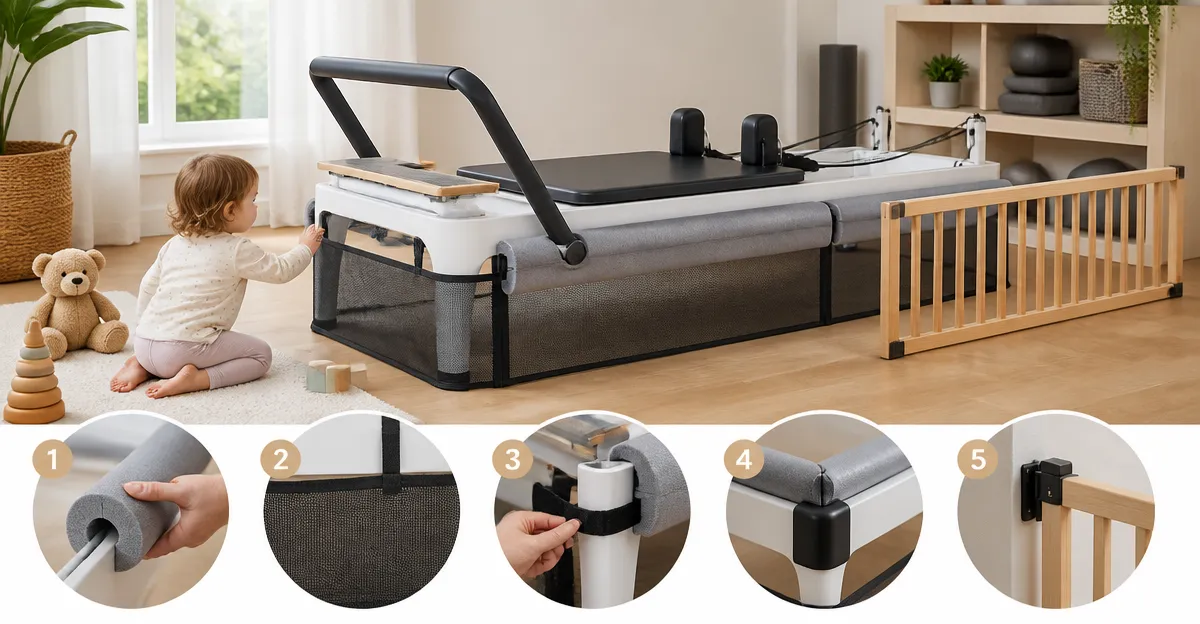
Designate the workout area as a “no‑play” zone. Install a baby gate or a decorative barrier that matches your home décor. Position the gate at least 2 ft away from the reformer to give you ample space for full‑range movements.
Use visual cues such as a brightly colored mat or a “Do Not Enter” sign to reinforce the boundary. Consistency is key; children quickly learn to respect areas that are consistently off‑limits.
Why this matters: Physical barriers reduce the chance of accidental contact, while visual signals help toddlers understand the rules without constant supervision.
Tips & Pro Tips
- Perform a safety walk‑through after each workout to ensure no small items (toys, socks) are left on the carriage.
- Apply a non‑toxic, clear floor sealant around the reformer’s base to prevent water damage from spills.
- Schedule a monthly tightening session for all bolts and pins; a simple wrench set suffices.
- Consider using a portable Bluetooth speaker with volume limits to keep music audible without startling a child.
- When folding the reformer, engage the locking pins before moving it; this prevents the frame from snapping open.
Conclusion
Childproofing a Pilates reformer combines thoughtful equipment selection, diligent maintenance, and strategic household organization. By following the five steps outlined above, one can enjoy daily workouts while ensuring toddlers remain safe. The recommended accessories—particularly the sturdy LeisureKing or Dpiolrcag reformer, non‑slip mats, and protective covers—enhance safety without compromising performance. Implement these practices today and create a harmonious space where fitness and family coexist peacefully.
Products Mentioned in This Guide
Frequently Asked Questions
How can I secure a Pilates reformer to prevent a toddler from climbing on it?
Use heavy‑duty anchor straps or wall‑mounted brackets to lock the reformer in place, and keep the foot bar and straps folded or locked when not in use.
What accessories help make a reformer safer for young children?
Install padded corner guards, a lockable carriage cover, and a non‑slip mat to reduce pinch points and prevent the unit from sliding.
Should I store the reformer’s springs and cords out of reach?
Yes, keep springs, cords, and adjustable knobs in a locked cabinet or high shelf to stop toddlers from pulling or entangling themselves.
How often should I inspect the reformer for child‑safety hazards?
Perform a quick safety check before each workout, looking for loose bolts, worn padding, or exposed metal that could harm a child.
Can I use a child‑proof gate to limit access to the home studio?
A sturdy gate or play‑pen around the studio creates a physical barrier, ensuring toddlers stay away from the reformer when you’re exercising.