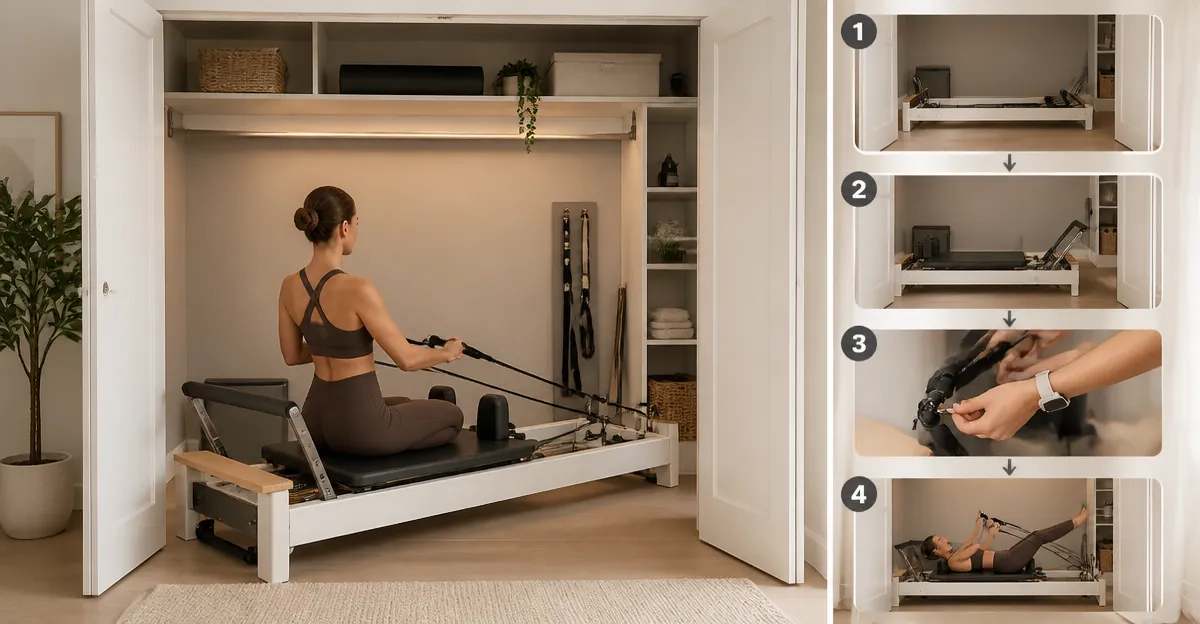
How to Do Reformer Workouts in a Closet: Step‑by‑Step Small‑Space Routine
In this guide the reader will learn how to transform a modest closet into a functional Pilates studio. The guide explains how to evaluate space, select appropriate equipment, and execute a complete reformer routine without sacrificing safety or effectiveness. By following the steps the reader can enjoy a full‑body workout at home while preserving valuable living area.
What You’ll Need
- A compact reformer or sliding board suitable for limited spaces.
- A non‑slip mat or protective floor padding.
- Adjustable resistance bands or springs.
- Basic accessories such as a phone holder for video guidance.
- Storage solutions for easy folding and stowing.
The following products have been selected from reputable manufacturers and meet the criteria for small‑space use. Each product is linked to its Amazon page for convenient purchase.
Step 1: Assess the Closet Dimensions and Prepare the Area
Measure the height, width, and depth of the closet to ensure that the equipment will fit with sufficient clearance for movement. A minimum clearance of 6 feet in height and 4 feet in width is recommended for most reformer exercises. Remove any hanging clothes, shelves, or clutter that could obstruct the workout space. Install a thin non‑slip mat on the floor to protect both the closet floor and the equipment.
When the space is cleared, place a portable light source if the closet lacks adequate illumination. Good lighting reduces the risk of misalignment during exercises and improves video visibility if the user follows an online class.
Step 2: Set Up a Compact Reformer Board
For users with very limited space the JANUA Pilates Board offers a foldable solution that combines sliding functionality with resistance bands. The board measures a compact footprint when folded, yet it expands to provide a full range of motion for core, shoulder, and leg exercises.
Key features include a multi‑function resistance band with a built‑in timer, a phone holder for streaming instructional videos, and an adjustable resistance system that accommodates beginners to advanced users. The board supports up to 400 lb, providing a safe platform for most body types. Priced at $94.90 with a rating of 4.2 out of 5 stars from 1,259 reviews, it represents a cost‑effective entry point for closet workouts.
To assemble, follow the quick‑start guide included in the package. Attach the resistance bands to the designated anchors, secure the board to the floor using the provided gripper pads (adding a small piece of non‑slip rubber can improve stability), and test the sliding motion before beginning the routine.
Step 3: Add Adjustable Height and Stability with a Foldable Reformer
If the user desires a more traditional reformer experience, the PAETA Reformer delivers a full‑size 86‑inch carriage that folds to occupy only 1.4 sq ft when stored. Its adjustable height stands allow the user to raise or lower the carriage to suit specific exercises, enhancing safety for beginners and providing challenge for advanced practitioners.
The machine features piano‑wire springs that deliver smooth, silent resistance, and a jump board for cardio‑style intervals. It supports up to 500 lb, ensuring stability during high‑intensity movements. Although priced at $419.09, the robust construction and versatility justify the investment for users who plan to expand their routine beyond the sliding board.
During setup, adjust the height stands to a comfortable starting level, attach the jump board if desired, and verify that all bolts are tightened securely. The included storage bags simplify folding after the workout, allowing the reformer to disappear into the closet until the next session.
Step 4: Create a Balanced Workout Sequence
Design a routine that alternates between core activation, lower‑body strengthening, and upper‑body conditioning. A typical 30‑minute session might include the following blocks:
- Warm‑up: 5 minutes of cat‑cow stretches on the board to mobilize the spine.
- Leg Press: 3 sets of 12 repetitions using the board’s resistance bands.
- Arm Springs: 3 sets of 10 repetitions on the PAETA Reformer, focusing on shoulder stability.
- Footwork: 4 sets of 15 repetitions on the PAETA carriage, adjusting spring tension for progressive overload.
- Jump Board Cardio: 2 minutes of low‑impact jumps to elevate heart rate.
- Cool‑down: 5 minutes of hamstring and hip flexor stretches on the board.
Each exercise should be performed with controlled breathing, inhaling during the release phase and exhaling during the effort phase. The JANUA Board’s built‑in timer helps maintain consistent intervals, while the PAETA Reformer’s adjustable springs enable precise resistance adjustments.
Step 5: Incorporate Advanced Features for Variety
For users who wish to add complexity, the Fairgom Pilates Reformer offers a dual‑resistance system that combines springs and cords. This configuration allows rapid changes in intensity without re‑configuring the entire machine, making it ideal for interval training within a confined area.
The Fairgom model supports up to 400 lb, includes a reinforced carbon‑steel frame, and arrives 90 % pre‑assembled, reducing setup time to under ten minutes. Priced at $259.99 with a stellar rating of 4.9 out of 5 stars from 12 reviews, it provides a premium experience for users seeking studio‑grade performance in a closet.
During a session, the user can switch from a spring‑based leg press to a cord‑based upper‑body pull without leaving the workspace. This fluid transition maximizes workout efficiency and keeps the heart rate elevated.
Step 6: Cool‑Down, Clean‑Up, and Storage
After completing the routine, allocate five minutes for static stretching on the board to promote flexibility and reduce muscle soreness. Use the built‑in timer on the JANUA Board to track each stretch interval.
Wipe down all surfaces with a mild disinfectant to maintain hygiene, especially if the closet is shared. Fold the PAETA Reformer and store it in its provided bag, then slide the JANUA Board back into its compact position. Ensure that the closet door can close without pressing against any equipment.
Tips & Pro Tips
- Place a small piece of rubber mat under the board’s gripper pads to improve floor traction and prevent sliding.
- Use a phone holder on the board to follow professional Pilates videos, ensuring proper form.
- Adjust spring tension in small increments; overly aggressive resistance can compromise joint alignment in a confined space.
- Schedule workouts during daylight hours if possible, as natural light enhances mood and reduces eye strain.
- Periodically check all bolts and fasteners on the PAETA Reformer to prevent loosening during repeated folding.
Troubleshooting
| Problem | Possible Cause | Solution |
|---|---|---|
| Board slides unintentionally | Insufficient grip on floor | Apply a non‑slip rug or add adhesive pads beneath the board. |
| Reformer makes squeaking noise | Spring tension not evenly distributed | Loosen and retighten the spring anchors; lubricate moving parts with silicone spray. |
| Jump board feels unstable | Improper attachment to carriage | Verify that the locking pins are fully engaged and tighten any loose bolts. |
Conclusion
By assessing the closet dimensions, selecting appropriate equipment, and following a structured routine, the reader can perform effective reformer workouts in a space as small as a typical bedroom closet. The combination of the JANUA Pilates Board, PAETA Reformer, and Fairgom Reformer provides scalable options for beginners to advanced practitioners. Consistent practice will improve core strength, flexibility, and overall fitness without the need for a dedicated home gym.
Products Mentioned in This Guide
Frequently Asked Questions
What minimum closet dimensions are required for a compact reformer workout?
Measure the height, width, and depth and ensure at least 6 ft of vertical clearance and enough horizontal space for the reformer plus a few inches of movement around it.
Can a sliding board replace a traditional reformer in a small closet?
Yes, a sliding board offers a low‑profile, portable alternative that mimics reformer glides and fits tighter spaces.
How do I keep my closet reformer routine safe?
Use a non‑slip mat, maintain clear clearance around the equipment, and secure any cords or accessories to prevent tripping.
What accessories are essential for guided reformer workouts in a closet?
A phone holder for video instructions, adjustable resistance bands or springs, and basic padding are the key items.
How can I store the reformer when the workout is finished?
Choose a foldable or collapsible reformer that can be leaned against a wall or hung on sturdy brackets to free up closet space.